

Artificial intelligence has experienced tremendous growth in the past five years, and it is poised for further innovation in the future. Since the previous century, AI models have become more nuanced and technical, allowing them to process large amounts of data, generate independent responses to prompts and elevate machines beyond their previously-limited capabilities.
For those who have studied artificial intelligence – like computer science graduate Jonathan De Vita – these are exciting changes. However, even people who don’t have a specific interest in AI will also soon be noticing changes to their personal and professional lives. As more companies begin implementing AI, life is set to speed up and become central to machine training.
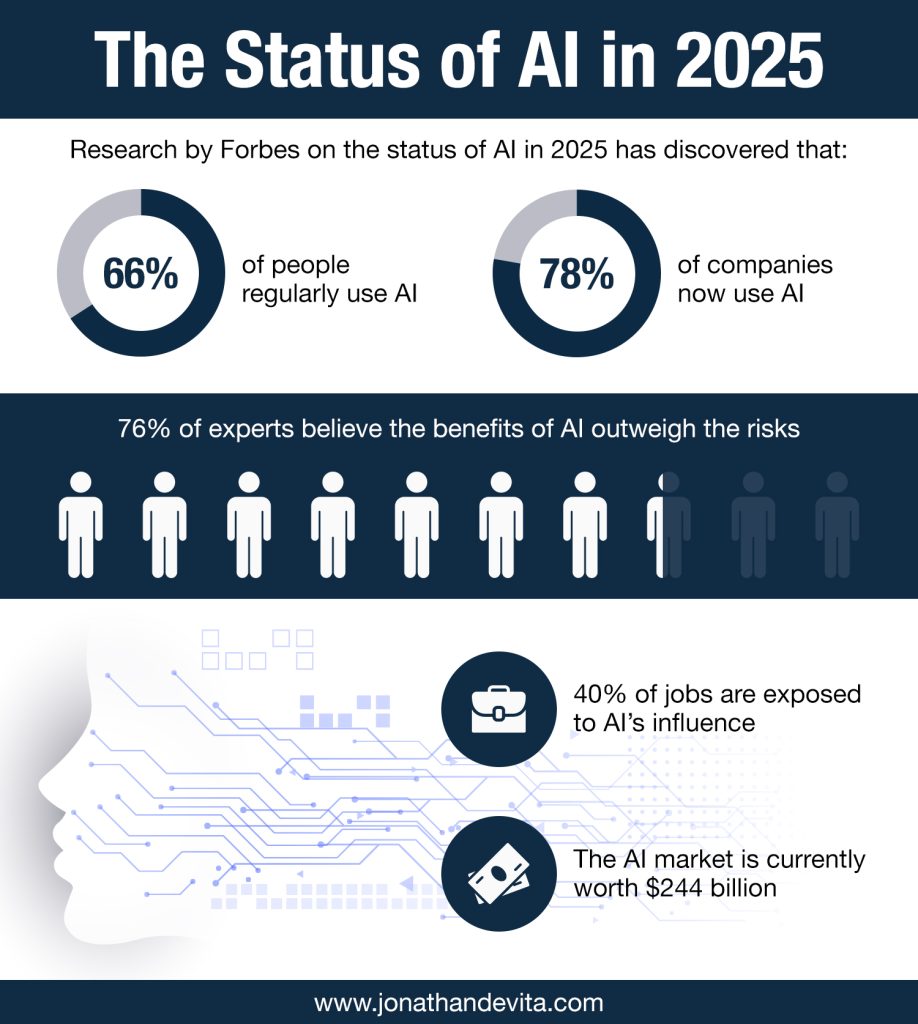
The latest trends predicted for AI in the coming years are focussed on specialising systems for different purposes, combining multiple models to boost efficiency and enable continuous machine training. There will be a focus on improving data quality to ensure that organisations have access to reliable information, as well as attempts to increase automation for administrative tasks, which would free up human labour for more complex assignments.
AI models are expected to take on bigger roles in very important industries, too. While it has already been used for analytical purposes in healthcare, generative AI is poised to become a key research tool for scientists. Such models can check and clean large data sets, providing vital conclusions that may well aid scientific discoveries. There is also interest in incorporating AI into decision-making technologies employed for national security jobs.
Even with AI’s rapid development thus far, the idea that these models would be capable of such independent thought and action was almost unthinkable. But now, experts predict that organisations will begin taking on ‘AI employees’, with systems designed to train and oversee other systems. This is already happening; language models are becoming more self-aware, allowing them to reason like humans do.
Everyday tasks, like shopping, are also set to become easier thanks to new AI trends. Customers will enjoy a more personalised retail experience, with customised recommendations and instant feedback. If used correctly, AI models could improve overall public efficiency and transform how individuals engage with the wider world.
The power of artificial intelligence is undeniable, and while many people are excited for the future, others are concerned about how rapidly AI is developing and becoming entangled with daily life. The burden is on senior individuals in the world of AI to manage and monitor these still-developing systems.